
2025-26 Departmental Results Report
The Honourable Sean Fraser, P.C., K.C. M.P.
Minister of Justice and Attorney General of Canada
Public Prosecution Service of Canada
Cat. No. J76-6E-PDF
ISSN 2560-9343
Contents
- At a glance
- From the Director of Public Prosecutions and Deputy Attorney General of Canada
- Results: What we achieved
- Spending and human resources
- Supplementary information tables
- Federal tax expenditures
- Corporate information
- Definitions
Note
The Public Prosecution Service of Canada (PPSC)Footnote 1 developed the content of this report with some support from its generative AI tool (Copilot Chat). A human author directed the development of the report and has reviewed and validated all AI-generated content.
At a glance
This departmental results report details the PPSC’s actual accomplishments against the plans, priorities and expected results outlined in its 2025-26 Departmental Plan.
These results align with the priorities outlined in the May 21, 2025, mandate letter from the Prime Minister, as well as with the PPSC’s vision, mission, raison d’être and operating context.
Key priorities
The PPSC identified the following key priorities for 2025-26:
- Foster a Culture of Trust and Engagement;
- Advance Equity, Diversity, Inclusion and Accessibility in the Workplace;
- Take Action Against Systemic Discrimination and Racism in the Criminal Justice System; and
- Modernize the Way We Work.
Highlights
The PPSC’s mission is to serve the public interest and contribute to a safe and just Canada. In carrying out its mandate, the PPSC conducts prosecutions independently, impartially, and fairly, while protecting the rights of every individual. The constitutional independence of the Director of Public Prosecutions underpins the integrity of prosecutorial decision-making and reinforces public confidence in the administration of justice. Guided by these principles, all PPSC employees play a role in upholding public trust and advancing a criminal justice system that is more equitable and fair for all Canadians.
Over the past year, the organization made steady progress in strengthening prosecution services, advancing fairness, and modernizing how it works. These efforts reflect a continued focus on delivering effective prosecution services in an increasingly complex criminal justice environment shaped by the growing use of digital technologies.
The PPSC continued to work closely with law enforcement agencies across the country to prosecute serious and complex offences, including files related to high-level drug trafficking, national security, financial crime, and foreign interference. Prosecutors provided timely and comprehensive legal analysis of how investigative decisions may affect the assessment of police files that may be referred for prosecution so that investigators can make informed decisions about obtaining evidence that could be admissible during a prosecution.
The organization also advanced Equity, Diversity, Inclusion and Accessibility in both its prosecution work and workplace. Prosecutors continued to integrate Indigenous and equity considerations into decision-making, consistent with established legal principles. Internally, the PPSC continued to focus on encouraging an inclusive and accessible workplace by promoting awareness, engagement, and leadership accountability.
Modernization also remained a key priority. The PPSC expanded the use of digital tools and technologies to support its day-to-day work, including systems for managing evidence and sharing information securely. These improvements are helping the organization manage cases more effectively and operate more efficiently overall.
- Total actual spending (including internal services): $227,088,415
- Total full-time equivalent staff (including internal services): 1,117
For detailed information on the PPSC’s total spending and human resources, read the Spending and human resources section of this report.
Summary of results
The following provides a summary of the results the department achieved in 2025-26 under its “core responsibility” (its main area of activity).
Core responsibility 1: Prosecution Services
- Actual spending
- $189,554,065
- Actual human resources
- 917
In 2025-26, the PPSC delivered on its mandate to prosecute federal offences and provide equitable, independent and impartial legal analysis to law enforcement and investigative agencies about investigations that may lead to a prosecution, while upholding the rule of law. The PPSC continued to focus on complex and high-impact areas, including drug-related offenses, regulatory and economic crime, terrorism prosecutions, and Criminal Code prosecutions in the territories.
Over the reporting period, the PPSC:
- Strengthened collaboration with investigative agencies, by providing early and ongoing legal analysis on investigative techniques and evidentiary requirements to ensure evidence obtained supports the effective conduct of complex prosecutions.
- Maintained efforts to strengthen fairness and reduce systemic barriers by reviewing and modernizing prosecutorial practices and policies with an intersectional and reconciliatory approach.
- Ongoing preparatory work and updates to key guidelines to the Public Prosecution Service of Canada Deskbook (PPSC Deskbook) were initiated to support consistent, fair, and unbiased decision-making and help to address discrimination, systemic racism, or over-representation of Indigenous, Black, racialized and marginalized groups in the criminal justice system.
- Advanced truth and reconciliation through the implementation of a new Indigenous Justice Portfolio to support reconciliation, strengthen relationships with Indigenous communities, and uplift Indigenous employees across the organization.
- Supported approaches aimed at addressing the root causes of offending, including the continued development and expansion of Drug Treatment Courts across Canada, which contribute to improve long-term outcomes and community safety.
- Advanced digital tools supporting prosecution services, including systems for evidence handling and secure document transfer, to strengthen legal case management and support the effective conduct of prosecutions. The PPSC also accelerated work to replace its legal case management systems, and responsibly integrated Artificial Intelligence tools to enhance efficiency and transparency without compromising the values that define its mandate.
Together, these achievements reflect the PPSC’s commitment to delivering fair, effective, and modern prosecution services that maintain public confidence in Canada’s justice system.
For more information on the PPSC’s activities related to Prosecution Services, read the “Results: What we achieved” section of this report.
From the Director of Public Prosecutions and Deputy Attorney General of Canada

George Dolhai
Director of Public Prosecutions and
Deputy Attorney General of Canada
I am pleased to present the Public Prosecution Service of Canada's (PPSC) Departmental Results Report (DRR) for 2025-26.
Over the past year, we remained focused on delivering fair and principled prosecution services while upholding the rule of law and maintaining public confidence in Canada's criminal justice system.
Our employees demonstrated exceptional professionalism, expertise, and dedication in carrying out this important work. Whether providing early legal analysis of the lawfulness of proposed investigatory steps as part of the assessments of their potential impact on the availability of evidence in a potential prosecution of alleged complex criminal activities, prosecuting serious offences before the courts, or supporting operations across the country, they continued to serve Canadians with integrity and sound judgment. Their efforts helped ensure that prosecutions were conducted fairly, decisions were based on the merits of each case, and justice was administered in accordance with the values and principles that underpin our legal system.
During 2025-26, the PPSC remained focused on prosecuting offences that pose the greatest risks to public safety and national security. Prosecutors continued to prioritize major drug trafficking, production, importation, and exportation cases involving illicit substances that have devastating impacts on Canadian communities. We also maintained a strong focus on threats to national security, whether rooted domestically or linked to foreign interference, while continuing to prosecute complex regulatory, economic, and territorial Criminal Code offences. We provided timely legal analysis during sophisticated investigations and ensured prosecutions were conducted fairly, effectively, and in accordance with the rule of law. These efforts helped lawfully address serious criminal activity and safeguard the safety and security of Canadians.
The PPSC also advanced important initiatives to strengthen fairness within the criminal justice system and address systemic barriers. Through the ongoing review and modernization of prosecutorial policies and practices in the PPSC Deskbook, we continued to promote consistent, fair, and unbiased decision-making. These efforts were informed by an intersectional and reconciliatory approach that recognizes the diverse realities and experiences of Indigenous, Black, racialized, and marginalized communities and supports a more equitable administration of justice.
Advancing reconciliation remained an important priority throughout the year. The establishment of a new Indigenous Justice Portfolio marked a significant step in strengthening relationships with Indigenous communities, supporting reconciliation, and advancing initiatives that help foster a more inclusive organization. This work reflects our ongoing commitment to ensuring that Indigenous perspectives and experiences are meaningfully considered in our policies, practices, and workplace culture.
We also continued to advance approaches that recognize the complex realities of Canadians who come into contact with the criminal justice system. By supporting the ongoing development and expansion of Drug Treatment Courts (DTCs) across Canada and other measures that address the root causes of offending, the PPSC sought to promote a fairer and more equitable justice process. These efforts acknowledge the diverse lived experiences of individuals involved in the justice system, including victims of crime, while supporting rehabilitation, reducing recidivism, and contributing to safer communities.
Modernization remained a key focus in 2025-26. We advanced digital tools that support prosecution services, including systems for evidence handling and secure document transfer, while accelerating work to replace legacy legal case management systems. The PPSC also continued the responsible integration of artificial intelligence tools to enhance efficiency and transparency. As we pursue innovation, our commitment to fairness, objectivity, and prosecutorial independence remains unwavering. Technology must support, and never compromise, the principles that define our mandate and guide our decision-making.
The accomplishments presented in this report are a testament to the professionalism, dedication, and resilience of PPSC employees across the country. I extend my sincere gratitude to all employees for their contributions to our mandate and to their unwavering commitment to the rule of law. Through their efforts, the PPSC continues to deliver fair, effective, and modern prosecution services that uphold public trust, support safer communities, and reinforce confidence in Canada's justice system.
As we look to the future, we will continue to respond to emerging challenges with integrity, excellence, and innovation, while remaining firmly committed to the fair and independent administration of justice for all Canadians.
Results: What we achieved
Core responsibilities and internal services
Core responsibility 1: Prosecution Services
In this section
- Description
- Quality of life impacts
- Progress on results
- Details on results
- Key risks
- Resources required to achieve results
- Related government priorities
- Program inventory
Description
The PPSC prosecutes criminal and regulatory offences under federal law in an independent, impartial and fair manner. Its mandate is established by the Director of Public Prosecutions Act.
This Act outlines the responsibilities of the Director of Public Prosecutions (DPP), which include initiating and conducting federal prosecutions; intervening in proceedings that raise a question of public interest that may affect the conduct of prosecutions or related investigations; issuing guidelines to federal prosecutors; and advising law enforcement agencies or investigative bodies on general prosecution matters and particular investigations that may lead to prosecutions. The DPP also exercises any other power or carry out duty or function assigned by the Attorney General of Canada that is compatible with the Office of the Director of Public Prosecutions. For the purpose of carrying out these statutory responsibilities, the DPP holds the function of Deputy Attorney General of Canada.
Quality of life impacts
The PPSC is a national, independent, and accountable prosecuting authority. Its main objective is to prosecute cases under federal jurisdiction in a fair manner that is free from any improper influence.
Guided by its mission to serve the public interest, the PPSC contributes to a safe and just society for all people in Canada. The PPSC is committed to continuing to improve public safety outcomes for Canadians and to contribute to the change necessary to reduce discrimination and over-representation of certain groups of people in the criminal justice system, particularly Indigenous, First Nation, Métis, Inuit, Black, racialized, and marginalized persons.
In this context, the PPSC’s work is primarily aligned with the Good Governance domain, more specifically to the “Crime Severity Index”, “Confidence in Institutions”, “Discrimination and Unfair Treatment”, and “Confidence in Access to Fair and Equal Justice (criminal)” indicators. It also contributes to the Society domain through its support of the “Indigenous Languages” indicator.
Progress on results
This section details the department’s performance against its targets for each departmental result under Core responsibility 1: Prosecution Services.
Table 1 shows the target, the date to achieve the target and the actual result for each indicator under Timely and comprehensive legal advice is provided to investigative agenciesFootnote 2 in the last three fiscal years.
| Departmental Result Indicator | Target | Date to achieve target | Actual Result |
|---|---|---|---|
| Percentage of respondents satisfied with the timeliness of legal advice. | 80% | March 2026 | 2023-24: Not availableFootnote 3 |
| 2024-25: Not availableFootnote 3 | |||
| 2025-26: Not availableFootnote 3 | |||
| Percentage of respondents satisfied with the comprehensiveness of legal advice. | Greater than or equal to 65% | March 2026 | 2023-24: Not availableFootnote 3 |
| 2024-25: Not availableFootnote 3 | |||
| 2025-26: Not availableFootnote 3 |
Table 2 shows the target, the date to achieve the target and actual result for each indicator under Federal prosecutions are completed in a timely mannerFootnote 4 in the last three fiscal years.
| Departmental Result Indicator | Target | Date to achieve target | Actual Result |
|---|---|---|---|
| Number and percentage of cases that went to trial and resulted in a judicial stay of proceedings due to Crown delay. | Less than 4% | March 2026 | 2023-24: 0.06% |
| 2024-25: 0.01% | |||
| 2025-26: 0.01%Footnote 5 | |||
| Number and percentage of cases that went to trial and resulted in the Crown directing a stay of proceedings due to Crown delay. | Less than 4% | March 2026 | 2023-24: 0.04% |
| 2024-25: 0.04% | |||
| 2025-26: 0.02%Footnote 6 |
Table 3 shows the target, the date to achieve the target and actual result for each indicator under Through professionally conducted prosecution-related work, the ODPP contributes to the administration of justice in the last three fiscal years.
| Departmental Result Indicator | Target | Date to achieve target | Actual Result |
|---|---|---|---|
| Number and percentage of prosecutions that result in a determination on the merits of the evidence. | Greater than or equal to 96% | March 2026 | 2023-24: 99.64% |
| 2024-25: 99.69% | |||
| 2025-26: 99.69%Footnote 7 | |||
| Number and nature of judicial stays for abuse of process based on the conduct of a federal prosecutor. | 0 | March 2026 | 2023-24: 0 |
| 2024-25: 0 | |||
| 2025-26: 0 | |||
| Number and nature of successful malicious prosecution lawsuits. | 0 | March 2026 | 2023-24: 0 |
| 2024-25: 0 | |||
| 2025-26: 0 | |||
| Number and nature of substantiated complaints made pursuant to the PPSC’s Complaint Policy. | 0 | March 2026 | 2023-24: 1 |
| 2024-25: 0 | |||
| 2025-26: 1Footnote 8 |
The Results section of the Infographic for the PPSC on GC Infobase page provides additional information on results and performance related to its program inventory.
Details on results
The following section describes the results for Prosecution Services in 2025-26 compared with the planned results set out in the PPSC’s departmental plan for the year.
Public Prosecution Service of Canada Deskbook Review
Results achieved
In 2025-26, the PPSC’s National Prosecution Policy Committee (NPPC) continued its review of Guidelines of the PPSC Deskbook with an intersectional lens. The goal was to ensure that prosecutorial guidelines support fair, equitable decisions, and take active steps to avoid bias, racism, and systemic discrimination.
The PPSC Deskbook sets out the guiding principles which all federal prosecutors, and persons acting as federal prosecutors, must follow. In 2021, the Director of Public Prosecutions (DPP) tasked our NPPC to review the PPSC Deskbook and recommend changes to any policy or practice that may contribute to discrimination, systemic racism, or over-representation of Indigenous, First Nation, Métis, Inuit, Black, racialized, and marginalized persons in the criminal justice system.
As a result of this work, the DPP approved updates to the following guideline in 2025-26:
- Guideline 5.7 – Impaired Driving Cases: Notice to Seek greater Punishment. This revised guideline clarifies the circumstances in which prosecutors must seek mandatory minimum sentences for repeat impaired driving offences. It also sets out the criteria to be considered when determining whether “exceptional or compelling” circumstances justify a decision not to seek a mandatory minimum sentence. In addition, the guideline requires prosecutors to consider the over-representation and systemic discrimination of First Nations, Métis, and Inuit members; and provides guidance to prosecutors when they make the decision to defer sentencing to allow an offender to undergo treatment.
In addition, significant progress was made on the review of the following guidelines:
- Guidelines 5.5, Domestic Violence and 5.6, Victims of Crime were combined, with a draft prepared by the NPPC. Work continues to finalize the updated guideline and to seek feedback from stakeholders.
- The revised Sentencing chapter, in Part VI of the PPSC Deskbook, was reviewed and edited by the NPPC. This reflects revisions to guidelines 6.2-6.4 and 6.6-6.7. The draft will be circulated to stakeholders for feedback.
National Security
Results achieved
The PPSC’s mandate covers terrorism offenses under the Criminal Code, offences under the Security Offenses Act, the Security of Information Act, and the Crimes Against Humanity and War Crimes Act. The organization is the prime sole legal advisor in that regard during the early investigative stages, and prime sole authority for initiating cases relating to the national security of Canada. The volume of national security investigations and prosecutions continues to significantly grow.
- In 2025-26, experienced federal prosecutors provided pre-charge legal analysis and other forms of legal assistance to the Royal Canadian Mounted Police (RCMP) as well as to local police forces in the context of investigations into terrorism and foreign interference offences. Prosecutors continued to conduct numerous complex terrorism prosecutions, considering the physical security of Canadian society and the fundamental rights and freedoms that all citizens consider essential to the well-being of Canadian society. At the same time, the PPSC, on behalf of the Attorney General of Canada, consented to commence terrorism proceedings, resulting in 12 individuals being charged with terrorism offences.
- During the same period, the PPSC’s prosecutors responded to terrorism and violent extremism in a rapidly evolving threat environment, including cases involving the recruitment of vulnerable young persons into extremist and violent ideologies. A total of 20 individuals were facing terrorism-related offences before the courts, including eight young persons. Additionally, ten terrorism peace bond proceedings were before the courts, six of which involved young persons. These figures indicate a growing involvement of youth in terrorism-related offences and precursor activities.
- Prosecutors also addressed foreign state-related activities intended to undermine Canadian security through intimidation, the theft of intellectual property, and the breach of international law.
Drug Prosecutions under the Controlled Drugs and Substances Act and the Cannabis Act
Results achieved
The PPSC is responsible for prosecuting offences under federal statutes across Canada, including drug-related offences under the Controlled Drugs and Substances Act (CDSA) and the Cannabis Act. In the territories, the PPSC prosecutes all Criminal Code offences and federal statutes and also prosecutes certain territorial offences on behalf of territorial governments. In Quebec and New Brunswick, the PPSC only prosecutes drug offences when the RCMP is the investigating agency. Drug prosecutions represent over 68% of PPSC’s work.
As Canada continues to face a national opioid death crisis caused by the distribution of fentanyl, often linked to organized crime, PPSC prosecutors work tirelessly to ensure that related criminal charges are brought before the courts. They also provide legal analysis to law enforcement agencies about the potential impact of investigative steps on prosecutions involving the disruption of Canada’s illicit drug supply.
- During 2025-26, the PPSC supported law enforcement efforts to disrupt the trafficking and domestic production of fentanyl, its analogues, and other opioids that contribute to Canada’s toxic drug supply. In the provinces, this assistance focused on cases involving criminal organizations operating locally, interprovincially, and at Canada’s sovereign borders. Prosecutorial analysis extended to complex investigations involving significant quantities of illicit substances – such as multi-kilogram quantities of fentanyl, large cocaine shipments, and methamphetamine distribution – as well as operations targeting money laundering and depriving offenders of illicit gains.
- The PPSC also addressed evolving challenges associated with synthetic drugs, including emerging substances and contaminants in the drug supply, and complex cases involving clandestine laboratories. In 2025-26, prosecutors supported the admissibility of evidence by advising on investigative techniques and defending their legality before the courts. This work was guided by the careful exercise of prosecutorial discretion, including consideration of substance use disorders, individual vulnerability, and the impacts of systemic discrimination and bias, while maintaining a focus on enforcement against individuals who direct and profit from criminal activity.
- In parallel, courts across Canada continued to impose significant custodial sentences for commercial fentanyl trafficking, reflecting the serious harm caused to communities and reinforcing deterrence and denunciation. The PPSC supported these outcomes by presenting comprehensive evidence on the dangers posed by fentanyl and, where appropriate, appealing sentencing decisions that did not reflect the gravity of the offences.
Drug Treatment Courts
Results achieved
Drug Treatment Courts (DTCs) are specialized courts that provide an alternative to incarceration by offering an opportunity to complete a drug treatment program under the supervision of designated justice system participants and treatment service providers. DTCs aim to reduce the frequency of crimes committed to support drug dependence and the harm people cause to themselves and others because of drug addiction. Offenders who meet specified criteria receive comprehensive substance use treatment, clinical case management and social services support as an alternative to incarceration. Prosecutors are required to consider the alternatives to prosecution that may address the public safety elements in those circumstances. At the same time, prosecutors are being trained to recognize and consider the potential effects of bias and systemic discrimination upon the assessment of these cases. This approach supports offenders in addressing their cycle of problematic substance use and criminal behaviour. It has been successful as a means of reducing criminal recidivism.
- Building on policy updates introduced in 2024 to increase flexibility in DTC programming, the PPSC further expanded eligibility criteria in 2025-26, improving access for individuals charged with criminal offences where there is underlying problematic substance use.
- Over the past year, the availability of DTCs continued to grow across Canada, with additional programs established in Saskatchewan, Ontario, and Newfoundland, while the use of therapeutic justice programs was expanded in Quebec.
Indian Act Bylaw Prosecutions: The Manitoba Keewatinowi Okimakanak Inc. (MKO) Pilot Project
Results achieved
First Nations across the country are actively looking for mechanisms with which to enforce and prosecute their laws. Although the PPSC’s jurisdiction in this area is constrained by statute, the PPSC is working with other federal, provincial and First Nations partners to contribute, within the scope of its mandate and resources, to addressing gaps in the prosecution of First Nation laws.
- Throughout 2025–26, the PPSC has had some success in advancing the pilot project, including helping to establish a path forward for other First Nations communities seeking to enact constitutionally sound and enforceable intoxicants by-laws; developing a process for MKO by-law tickets to be filed with the provincial court; and identifying common challenges and barriers related to the enforcement and prosecution of Indian Act by-laws across Canada. Further, the PPSC has committed to a one-year transition period after the conclusion of the pilot project to provide the MKO with time to make alternative arrangements for the prosecution of Indian Act by-law violations in MKO communities. We will be meeting with MKO to discuss whether they will accept the transition plan as proposed.
Tax Evasion Cases
Results achieved
The PPSC prosecutes offences under the statutes enforced by the Canada Revenue Agency (CRA), the Canada Border Service Agency (CBSA), and the Royal Canadian Mounted Police (RCMP), notably those dealing with tax evasion and contraband tobacco and cannabis.
Specialized PPSC prosecutors provide prosecutorial analysis during the investigative stage, conduct prosecutions, and provide training to investigators. CRA investigations focus on complex tax evasion schemes, including cross-border crime and offences committed by organized groups.
Dedicated regulatory and economic crimes prosecution teams across the country are responsible for prosecuting offences under more than 75 federal statutes and regulations. These are among the most complex offences handled by the PPSC, often raising cutting-edge legal issues.
- Throughout 2025–26, PPSC offices continued to effectively manage high volumes of CRA files. Dedicated regulatory and economic crime teams facilitated earlier and more comprehensive prosecutorial engagement, while smaller offices ensured complex CRA files were assigned to experienced senior prosecutors.
- The PPSC continued to provide critical pre-charge prosecutorial legal assessments, comprehensive training, and thorough reviews of Information to Obtain (ITO) warrants. Ongoing guidance on search warrant execution contributed to the consistent and effective conduct of CRA investigation.
Key risks
In 2025-26, the PPSC continued to manage key corporate risks that could affect the delivery of its mandate. The 2024-27 Corporate Risk Profile (CRP) guided the organization’s approach to identifying, monitoring, and mitigating risks, within an increasingly complex criminal justice environment characterized by evolving legal requirements, growing case complexity, and external system pressures.
During the reporting period, the PPSC strengthened governance and oversight mechanisms to support the ongoing monitoring of risk mitigation strategies. This included enhancing internal tools and procedures, as well as coordination across functions, to improve the availability, consistency, and timeliness of risk information. These efforts are intended to support a more effective communication or risk insights and to enable their integration into senior management decision-making processes.
The PPSC’s risk landscape continued to be shaped by operational demands associated with prosecuting complex and high-volume cases. To support workforce sustainability and safety, the organization maintained measures to protect prosecutors and personnel involved in sensitive and high-risk prosecutions, while continuing efforts to attract and retain a skilled and diverse workforce.
Risks related to information management and digital tools were addressed through targeted improvements to support the secure handling of evidence and information disclosure, as well as ongoing work to replace its legacy internal Legal Case Management System. These efforts contributed to maintaining the integrity of prosecution processes and supporting effective case management.
The PPSC also advanced mitigation measures related to fairness and systemic discrimination risks by continuing to review and modernize prosecutorial policies using an intersectional approach, supported by targeted training. These efforts promote consistent and unbiased decision-making and help ensure that prosecution practices align with evolving legal standards and public expectations.
Overall, mitigation measures helped the PPSC manage key risks and maintain continuity in prosecution services, although external pressures, including courts delays and increasing case complexity, continued to influence operational outcomes.
Resources required to achieve results
Table 4 provides a summary of the planned and actual spending and full-time equivalents required to achieve results.
| Resource | Planned | Actual |
|---|---|---|
| Spending | 195,899,339 | 189,554,065 |
| Full-time equivalents | 905 | 917 |
The Finances section of the Infographic for the PPSC on GC Infobase page and the People section of the Infographic for the PPSC on GC Infobase page provide complete financial and human resources information related to its program inventory.
Related government priorities
This section highlights government priorities that are being addressed through this core responsibility.
Gender-based Analysis Plus (GBA Plus)
The PPSC recognizes the importance of its role in the Canadian criminal justice system and remains committed to reconciliation, equity, diversity, inclusion and accessibility. These commitments are reflected in the organization’s core value and priorities.
In 2025-26, the PPSC implemented a new mandatory course, Introduction to Gender-based Analysis Plus, for all employees and all members of its agent firms (private-sector law firms).
United Nations 2030 Agenda for Sustainable Development and the UN Sustainable Development Goals
Following a strategic assessment conducted by Environment and Climate Change Canada (ECCC), the PPSC was identified as one of 28 federal entities recommended for removal from the reporting requirements of the Federal Sustainable Development Act (FSDA). The recommendation, made in November 2024, was approved by the Minister of ECCC and subsequently approved by the Governor General and registered by the Privy Council Office in February 2026. The decision was based on factors including the organization's mandate relevance to sustainable development, size, budget, workforce, and existing reporting obligations. This initiative aims to maximize the impact of the FSDA while promoting efficient reporting and the effective use of public resources.
Artificial intelligence
The PPSC continued to modernize its workplace in 2025-26 to support its role as Canada’s national, independent, and accountable prosecution authority. Modernization remained a priority to respond to the evolving criminal justice landscape, including the rising complexity of cases, evolving legal frameworks, and the growing use of digital technologies by police, defence counsel, and the courts.
In line with the Federal Public Service’s Artificial Intelligence (AI) strategy, the PPSC adopted a measured and responsible approach to integrating AI tools and digital capabilities into daily workflows. During the reporting period, the organization reached a significant milestone in foundational AI activities by developing internal policies and governance through a departmental AI tiger team. It also enabled enterprise-wide use of Copilot Chat through awareness efforts, training, and a prompt library to support consistent and accessible uptake. This tool allows PPSC employees to securely optimize administrative tasks, manage information up to “Protected B” level, and streamline daily operational activities.
At the same time, the increasing use of technologies such as body-worn cameras by police services has resulted in a significant growth in electronic evidence, thereby accelerating the shift away from paper-based disclosure. In response, the PPSC continued to explore the use of AI and digital tools to support the handling and review of large volumes of digital evidence. This work included assessing technical requirements, such as infrastructure, system integration, and ongoing support considerations, to ensure that solutions are secure, reliable, interoperable, and aligned with operational needs.
These modernization efforts are essential to maintaining the effectiveness of prosecution services in a rapidly evolving environment. Simultaneously, they require sustained investments in technology, infrastructure, and specialized expertise, as well as careful prioritization of available resources. As demands for digital capacity continue to grow, the pace and scope of implementation remain influenced by funding levels, internal capacity, and the need to balance operational requirements with long-term transformation objectives.
Overall, these efforts supported improved efficiency in evidence handling and case management, while reinforcing the PPSC’s ability to operate within an increasingly digital justice system. The organization continued to advance modernization initiatives in a deliberate manner, ensuring that all technological developments align with its mandate and its unwavering commitment to fairness, objectivity, and integrity.
Program inventory
Prosecution Services is supported by the following programs:
- Federal Prosecutions
Additional information related to the program inventory for Prosecution Services is available on the Results page on GC InfoBase.
Internal services
In this section
- Description
- Progress on results
- Resources required to achieve results
- Risk and compliance process
- Contracts awarded to Indigenous business
Description
Internal services are the activities and resources that support a department in meeting its corporate obligations and delivering its programs. The 10 categories of internal services are:
- acquisition management services
- communications services
- financial management services
- human resources management services
- information management services
- information technology services
- legal services
- material management services
- management and oversight services
- real property management services
Progress on results
This section presents details on how the department performed to achieve results and meet targets for internal services.
Corporate Services Branch
In 2025-26, the Corporate Services Branch (CSB)Footnote 9 continued to strengthen governance practices to support more coordinated business and investment decision-making across the organization. Building on progress achieved in previous years, the branch advanced the implementation of a structured project management framework, standardized tools, and consistent processes to support a more structured approach to planning and oversight.
In parallel, through its Administration Services Division, the CSB streamlined and consolidated key data collection practices and advanced efforts to simplify reporting processes. These actions improved the coherence of management dashboards and promoted greater consistency in how information is captured and presented. As a result, the quality and reliability of information available to senior management were strengthened, supporting clearer oversight and more informed decision-making.
Human Resources Directorate
In 2025-26, the Human Resources Directorate advanced the PPSC’s people-focused vision by strengthening talent management, succession planning, and workforce development, supported by the renewal of the 2025-2028 People Strategy. The PPSC continued to promote equity, diversity, and inclusion through enhanced hiring practices, bias mitigation measures, and stronger oversight of human resources practices, helping to build a workforce that better reflects the communities it serves.
The organization also made progress in implementing its Official Languages Action Plan, fostering a more bilingual and inclusive workplace. Employee mental health and well-being remained a priority through expanded access to support services, resources, training, and learning opportunities. In addition, the PPSC advanced key learning and development initiatives, including enhancements to the Federal Prosecutor Development Program and Competency Standard, strengthening the skills and capacity of its workforce.
Administrative Services Division
In 2025-26, the Administrative Services Division strengthened information management practices by reviewing disposition processes and advancing digital modernization initiatives. Efforts focused on transitioning from legacy shared drives to modern enterprise platforms for managing digital evidence, including piloting new tools and preparing for cloud-based storage adoption.
The PPSC also continued modernizing digital tools for prosecution services through the implementation of TitanFile and the pilot of Axon Justice across several regions to support digital disclosure. In addition, work progressed on identifying a replacement for the legacy Legal Case Management System in collaboration with Public Services and Procurement Canada, supporting the development of a sustainable, organization-wide solution.
National Fine Recovery Program
In 2025-26, the National Fine Recovery Program (NFRP), which administers the recovery of outstanding federal fines on behalf of the Crown and helps preserve the integrity of the justice system by enforcing court-ordered penalties, continued to strengthen its operations across Canada. Key initiatives included coordinating a national civil litigation contract to enhance the recovery of high-value and complex fines and successfully expanding fine recovery services to the Northwest Territories through the development of processes adapted to northern operational realities.
The NFRP also advanced implementation of its Fine Recovery Policy Framework by reviewing and updating its inventory of outstanding fines, introducing a new limitation period, and aligning recovery practices with updated policy requirements to support more consistent and effective collection efforts. In addition, substantial progress was made toward implementing the new WinCollect fine management system, including approvals, security assessments, and initial testing, positioning the program to improve the efficiency and consistency of fine recovery activities in 2026-27.
Agent Affair Program and National Agents Project
In 2025-26, the National Agents Project (NAP) advanced the modernization of the PPSC’s management of agent engagements through a structured national rollout, enhancing compliance with sections 32 and 34 of the Financial Administration Act. Following a successful pilot that established a national process, clarified roles and responsibilities, and improved coordination of agent-related expenditures, implementation was completed in Alberta, the National Capital Region, Saskatchewan, and Manitoba.
Building on these results, the PPSC approved the national rollout of the NAP and began restructuring the Agent Affairs Program by developing a standardized model for regional Agent Supervision Units, updating key positions, and realigning financial responsibilities. These efforts strengthened program governance and management while supporting the continued evolution of the program.
Equity, Diversity, Inclusion and Accessibility
In 2025-26, following a review of achievements under its 2021-2024 Equity, Diversity, Inclusion and Accessibility (EDIA) Action Plan, the PPSC strengthened its EDIA approach by focusing on measurable results, continuous improvement, accountability, and culture change. Guided by the Treasury Board Secretariat’s EDI Maturity Model, the Advancement Centre for Equity, Diversity and Inclusion (ACEDI) expanded its role as the organization’s centre of expertise by embedding equity considerations into corporate initiatives, emerging policy areas, and prosecutorial practices.
The PPSC further advanced reconciliation and inclusion through initiatives such as the creation of the Indigenous Justice Portfolio, updates to prosecutorial guidance to incorporate intersectional and Indigenous perspectives, and contributions to prosecutor development programs. Learning, accessibility, and employee engagement remained key priorities, supported by training, accommodation and accessibility guidance, and ongoing collaboration with employee councils and EDIA committees. The development of a new EDIA data dashboard also strengthened the organization’s ability to monitor workforce representation and employee experiences, supporting informed decision-making and continuous improvement.
Communications
In 2025-26, the PPSC continued to improve the accessibility and clarity of its communications by modernizing Access to Information and Privacy (ATIP), recruitment, and National Fine Recovery Program (NFRP) correspondence templates using plain language and web-based resources. These efforts supported broader initiatives to make information more accessible and reduce barriers for Canadians.
The PPSC also modernized its ATIP operations through the implementation of the ATIPXpress case management and redaction system and began reviewing its privacy policies to align with evolving Treasury Board requirements and strengthen privacy protections in the digital environment. In addition, the organization advanced employee awareness of access to information and privacy obligations through the testing of a new ATIP 101 course and preparations for department-wide training on legislative and policy requirements related to access to information and privacy.
Finance and Acquisitions
In 2025-26, the Finance and Acquisitions Directorate (FAD) strengthened workforce capacity and operational excellence by expanding training, introducing standardized tools and templates, and enhancing reporting and performance monitoring. These initiatives improved financial and procurement expertise, supported informed decision-making, and increased spending oversight across the organization.
The Directorate also reinforced financial accountability and data integrity through improvements to financial reporting, forecasting, monitoring, and internal controls, helping to ensure compliance, mitigate risks, and support effective resource management. In addition, FAD fostered collaboration with internal and external partners by providing expert advice, training, and practical support to facilitate policy and operational changes, contributing to effective change management, business continuity, and a culture of service excellence.
Audit and Evaluation
In 2025-26, the Internal Audit and Evaluation Division continued to support the assessment of organizational performance and results. This was achieved through various audit engagements (topics including the management of sensitive information, cyber security, and corporate risk mitigation strategies), responses to internal requests, and active participation on internal committees. As part of its annual risk-based audit planning exercise, the Division also maintained oversight of organizational risks and related mitigation strategies.
Resources required to achieve results
Table 5 provides a summary of the planned and actual spending and full-time equivalents required to achieve results.
| Resource | Planned | Actual |
|---|---|---|
| Spending | 31,402,258 | 37,534,350 |
| Full-time equivalents | 216 | 200 |
The Finances section of the Infographic for the PPSC on GC Infobase and the People section of the Infographic for the PPSC on GC Infobase provide complete financial and human resources information related to its program inventory.
Risk and compliance process
The Risk and Compliance Process (RCP) is a self-assessment designed to help deputy heads verify that they have controls and practices in place to meet their accountabilities under legislation and Treasury Board policy, and to effectively manage risks in their organizations.
In 2025-26, the Public Prosecution Service of Canada completed the RCP self-assessment.
The results show the department demonstrated appropriate practices and controls in several areas and identified opportunities to improve the department’s management practices in others. In response, the department will:
- strengthen oversight of outstanding remediation actions related to Financial and Expenditure Management internal control gaps by enhancing monitoring and reporting to the Chief Financial Officer and refining implementation timelines to better reflect resource capacity and external factors;
- strengthen procurement controls by advancing internal control reviews, reinforcing policy compliance and quality assurance, and increasing the use of automation where feasible; and
- formalize security governance and establish documented procedures to support consistent monitoring of security controls and improve overall management maturity.
Contracts awarded to Indigenous businesses
Government of Canada departments are required to award at least 5% of the total value of contracts to Indigenous businesses every year.
As shown in Table 6, the PPSC awarded 5.25% of the total value of all contracts to Indigenous businesses for the fiscal year.
| Contracting performance indicators | 2025-26 Results |
|---|---|
| Total value of contracts awarded to Indigenous businesses (A) | $315,818.88 |
| Total value of contracts awarded to Indigenous and non-Indigenous businesses (B) | $68,983,701.46 |
| Value of exceptions approved by deputy head (C) | $62,964,596.67 |
| Proportion of contracts awarded to Indigenous businesses | 5.25% |
Notes
For the purposes of the minimum 5% target, Indigenous Services Canada defines “Indigenous businesses” as:
- businesses owned and operated by Elders, band and tribal councils
- businesses registered in the Government of Canada’s Indigenous Business Directory
- registered on a modern treaty beneficiary business list
A “contract” is a binding agreement for the procurement of a good, service or construction and does not include real property leases. It includes contract amendments and contracts entered into by means of acquisition cards of more than $10,000.
The DPP has approved the exclusion of legal agent agreements since there is no availability in this commodity with Indigenous businesses. Also, it would not be operationally feasible to cancel the fixed-term agreements the PPSC already has in place with law firms, which, if cancelled, would have a detrimental impact on supporting its core mandate of prosecuting offences and providing legal analysis to law enforcement about prosecutions in general and about particular investigations that may lead to a prosecution.
In its 2026-27 Departmental Plan, the PPSC estimated that it would award 5% of the total value of its contracts to Indigenous businesses by the end of 2025-26.
Spending and human resources
In this section
Spending
This section presents an overview of the department’s actual and planned expenditures from 2023-24 to 2028-29.
Budgetary performance summary
Table 7 shows the money that the PPSC spent in each of the past three years on its core responsibilities and on internal services.
| Core responsibilities and internal services | 2025-26 Main Estimates | 2025-26 total authorities available for use | Actual spending over three years (authorities used) |
|---|---|---|---|
| Prosecution Services | 195,899,339 | 200,029,502 | 2023-24: 181,214,587 |
| 2024-25: 213,502,409 | |||
| 2025-26: 189,554,065 | |||
| Internal Services | 31,402,258 | 40,689,388 | 2023-24: 41,913,178 |
| 2024-25: 40,747,653 | |||
| 2025-26: 37,534,350 | |||
| Total | 227,301,597 | 240,718,890 | 2023-24: 223,127,765 |
| 2024-25: 254,250,062 | |||
| 2025-26: 227,088,415 |
Analysis of the past three years of spending
The total actual expenditures net increase from 2023-24 to 2024-25 is primarily due to the ratification of the collective agreements for the Law Practitioner and the Law Management groups.
Expenditures decreased in 2025-26 due to the absence of retroactive salary and lump-sum payments that were made in 2024-25. These one-time costs increased expenditures in the prior fiscal year and did not continue into 2025-26.
The variance of $13.6 million between the total authorities available and actual spending for 2025-26 stems from an operating surplus of $12.3 million and a surplus of $1.3 million related to the outsourcing of the collection of federal fines. Of the operating surplus, an amount of $11.1 million is eligible to be carried forward and spent in the next fiscal year.
The Finances section of the Infographic for the PPSC on GC Infobase provides more financial information from previous years.
Planned spending for the next three years
Table 8 shows the PPSC’s planned spending for each of the next three years on its core responsibilities and on internal services.
| Core responsibilities and internal services | 2026-27 planned spending | 2027-28 planned spending | 2028-29 planned spending |
|---|---|---|---|
| Prosecution Services | 197,706,150 | 197,706,150 | 197,706,150 |
| Internal services | 31,734,557 | 31,163,513 | 31,194,547 |
| Total | 229,440,707 | 228,869,663 | 228,900,697 |
Analysis of the next three years of planned spending
The PPSC’s planned spending reflects the amounts approved by Parliament to support the department’s core responsibility.
The Finances section of the Infographic for the PPSC on GC Infobase provides more detailed financial information related to future years.
Budgetary actual gross spending
Table 9 reconciles gross planned spending with net spending for 2025-26.
| Core responsibilities and internal services | 2025-26 actual gross spending | 2025-26 actual revenues netted against expenditures | 2025-26 actual net spending (authorities used) |
|---|---|---|---|
| Prosecution Services | 208,677,601 | 19,123,536 | 189,554,065 |
| Internal services | 37,654,912 | 120,562 | 37,534,350 |
| Total | 246,332,513 | 19,244,098 | 227,088,415 |
Analysis of budgetary actual gross spending summary
The PPSC’s revenue is primarily generated through its authority to recover amounts from other departments and for the provision of prosecutorial advice and prosecution services.
The Finances section of the Infographic for the PPSC on GC Infobase provides information on the alignment of the PPSC’s spending with Government of Canada’s spending and activities.
Funding
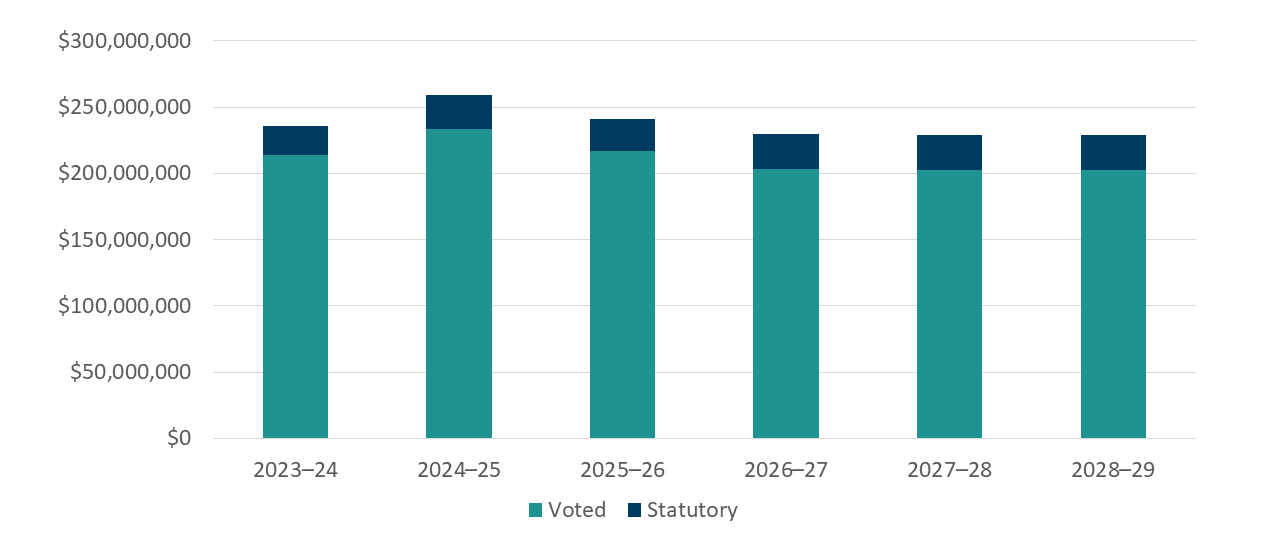
This section provides an overview of the department’s voted and statutory funding for its core responsibilities and for internal services.
Graph 1 summarizes the department’s approved voted and statutory funding from 2023-24 to 2028-29.
Text version
Graph 1 includes the following information in a bar graph.
| Fiscal year | Statutory | Voted | Total |
|---|---|---|---|
| 2023-24 | 21,839,159 | 213,711,670 | 235,550,829 |
| 2024-25 | 25,778,743 | 233,672,476 | 259,451,219 |
| 2025-26 | 24,002,485 | 216,716,405 | 240,718,890 |
| 2026-27 | 26,356,447 | 203,084,260 | 229,440,707 |
| 2027-28 | 26,274,793 | 202,594,870 | 228,869,663 |
| 2028-29 | 26,274,793 | 202,625,904 | 228,900,697 |
Analysis of statutory and voted funding over a six-year period
Funding for 2023-24, 2024-25, and 2025-26 reflects approved authorities (statutory and voted), including Main Estimates, Supplementary Estimates, adjustments, warrants, and transfers, as reported in the Public Accounts.
The total available authorities for the fiscal year 2025-26 amount to $240.7 million, representing a net decrease of $18.8 million from $259.5 million in fiscal year 2024-25.
The decrease is primarily attributable to the following:
- Decrease of $21.1 million dollars due to one-time expenditures in 2024-25 related to retroactive pay and lump-sum payments following the ratification of the Law Practitioner and Law Management collective agreements;
- Increase of $6.1 million of dollars in funding received for the National Inquiry into Missing and Murdered Indigenous Women and Girls (MMIWG);
- Decrease of $2.4 million dollars attributable to a lower operating budget carry-forward received in 2025-26 compared to the previous year;
- Decrease of $1.8 million dollars in contributions to Employee Benefit Plan (EBP) adjustment;
- Increase of $0.6 million dollars due to funding received for the ratification of multiple collective agreements; and
- Decrease of $0.2 million dollars in other smaller funding authorities.
Funding for 2026-27, 2027-28, and 2028-29 reflects amounts already included in the department’s reference levels, as well as amounts to be authorized through the Estimates process as outlined in the Department’s Annual Reference Level Update.
Consult the Public Accounts of Canada for further information on the PPSC’s departmental voted and statutory expenditures.
Financial statement highlights
This section presents the PPSC’s Financial statements (Audited/Unaudited) for the year ended March 31, 2026.
Table 10 summarizes the expenses and revenues for 2025–26, which net to the cost of operations before government funding and transfers.
| Financial information | 2025-26 actual results | 2025-26 planned results | Difference (actual results minus planned) |
|---|---|---|---|
| Total expenses | 269,453,465 | 274,479,116 | (5,025,651) |
| Total revenues | 22,827,231 | 22,742,000 | 85,231 |
| Net cost of operations before government funding and transfers | 246,626,234 | 251,737,116 | (5,110,882) |
Analysis of expenses and revenues for 2025-26
- Total expenses:
- Decrease of $5 million (or 1.8%) in actual total expenses ($269.5 million) compared to planned expenses ($274.5 million) for 2025-26.
- The decrease is explained by:
- Decrease of $5 million (or 1.8%) in the allowance for contingent liabilities, primarily due to the settlement of a pending case and a downward revision of the estimated liability for another case following a reassessment of its potential liability.
- Total revenues:
- Increase of $0.1 million (or 0.4%) in actual total revenues ($22.8 million) compared to planned total revenues ($22.7 million).
The increase is explained by prosecution services rendered to other government departments and agencies (OGDAs) being higher than planned.
The 2025-26 planned results information is provided in the PPSC’s Future-Oriented Statement of Operations and Notes 2025–26.
Table 11 summarizes actual expenses and revenues and shows the net cost of operations before government funding and transfers.
| Financial information | 2025-26 actual results | 2024-25 actual results | Difference (2025-26 minus 2024-25) |
|---|---|---|---|
| Total expenses | 269,453,465 | 296,614,755 | (27,161,290) |
| Total revenues | 22,827,231 | 17,751,878 | 5,075,353 |
| Net cost of operations before government funding and transfers | 246,626,234 | 278,862,877 | (32,236,643) |
Analysis of differences in expenses and revenues between 2024-25 and 2025-26
Decrease of $27.2 million (or 9.2%) in total expenses in 2025-26 ($269.4 million) compared to 2024-25 ($296.6 million). The cumulative decrease can be explained by:
- Decrease of $19.5 million (or 6.6%) in salary expenses, primarily because of new collective agreements being ratified in 2024-25, resulting in the issuance for retroactive pay and lump-sum payments in the previous fiscal year;
- Decrease of $1.3 million (or 0.4%) in professional and special services – counsel fees due to lower Crown agent billings compared to 2024-25;
- Decrease of $5 million (or 1.7%) in the allowance for contingent liabilities primarily due to the settlement of a pending case and a downward revision of the estimated liability for another case following a reassessment of its potential liability;
- Decrease of $1 million (or 0.3%) in rental costs due to nonrecurring information technology software license renewals being paid in 2024-25; and
- Decrease of $0.6 million (or 0.2%) in other operating expenses.
- Revenue by type:
- Increase of $5.1 million (or 28.6%) in revenues.
The total revenues earned in 2025-26 were $22.8 million compared to $17.7 million in 2024-25.
In 2025-26, the PPSC had the following revenue categories, including the revenues earned on behalf of Government:
- Respendable Revenue:
-
- Revenue earned from the provision of advisory and prosecution services to Other Government Departments and Agencies (OGDAs): $19.2 million (or 79.3% of revenue).
- Non-respendable Revenue:
- Employee Benefit Plan adjustment: $3.6 million (or 14.9% of revenue);
- Collection of fines, forfeitures and court costs: $0.6 million (or 2.5% of revenue); and
- Rent from residential housing provided to employees: $0.8 million (or 3.3% of revenue).
Table 12 provides a brief snapshot of the amounts the department owes or must spend (liabilities) and its available resources (assets), which helps to indicate its ability to carry out programs and services.
| Financial information | Actual fiscal year (2025-26) | Previous fiscal year (2024-25) | Difference (2025-26 minus 2024-25) |
|---|---|---|---|
| Total net liabilities | 38,910,083 | 55,990,776 | (17,080,693) |
| Total net financial assets | 25,996,042 | 38,185,577 | (12,189,535) |
| Departmental net debt | 12,914,041 | 17,805,199 | (4,891,158) |
| Total non-financial assets | 7,748,820 | 8,098,878 | (350,058) |
| Departmental net financial position | (5,165,221) | (9,706,321) | (4,541,100) |
Analysis of department’s liabilities and assets since last fiscal year
Decrease of $17.1 million (or 30.5%) in total net liabilities in 2025-26 ($38.9 million) compared to 2024-25 ($56 million).
- The cumulative decrease is explained by:
- Decrease of $16.5 million (or 29.4%) in accounts payable and accrued liabilities mainly due to:
- Reduction of Other government departments (OGD) – accounts payables: $5.8 million (or 10.4%);
- Reduction in accrued salaries – payable at year-end salaries: $5.6 million (or 10%);
- Reduction of our allowance for claims and pending and threated litigations: $5 million (or 8.9%); and
- Reduction of 0.1 million in other accounts payable and accrued liabilities.
- Decrease of $0.4 million (or 0.7%) in Vacation pay and compensatory leave allowances due to a decrease in employee vacation and compensatory leave balances; and
- Decrease of 0.2 million (or 0.4%) in other net liabilities.
- Decrease of $16.5 million (or 29.4%) in accounts payable and accrued liabilities mainly due to:
- Total net financial assets:
- Decrease of $12.2 million (or 31.9%) in total net financial assets in 2025-26 ($26 million) compared to 2024-25 ($38.2 million).
- The cumulative decrease can be explained by:
- Decrease of $13.1 million (or 34.3%) in due from Consolidated Revenue Fund mainly due to a decrease in accounts payable and accrued liabilities as explained above.
- Offset by:
- An increase of $0.9 million (or 2.4%) in accounts receivable and advances mainly due to an increase in overpayments not recognized by the pay centre.
- Total non-financial assets:
- Decrease of $0.4 million (or 4.9%) in total non-financial assets in 2025-26 ($7.7 million) compared to 2024-25 ($8.1 million). The decrease is explained by the amortization of tangible capital assets offset by tangible capital asset purchases.
Human resources
This section presents an overview of the department’s actual and planned human resources from 2023-24 to 2028-29.
Table 13 shows a summary in full-time equivalents of human resources for the PPSC’s core responsibilities and for its internal services for the previous three fiscal years.
| Core responsibilities and internal services | 2023-24 actual full-time equivalents | 2024-25 actual full-time equivalents | 2025-26 actual full-time equivalents |
|---|---|---|---|
| Prosecution Services | 920 | 942 | 917 |
| Internal services | 214 | 206 | 200 |
| Total | 1,134 | 1,148 | 1,117 |
Analysis of human resources for the last three years
The increase in 2024-25 full-time equivalents is due to the opening of a new office in Surrey, British Columbia.
The reduction in full-time equivalents in 2025-26 is primarily driven by significant volatility in the Northern regions and across regional offices.
Table 14 shows the planned full-time equivalents for each of the PPSC’s core responsibilities and for its internal services for the next three years. Human resources for the current fiscal year are forecast based on year to date.
| Core responsibilities and internal services | 2026-27 planned full-time equivalents | 2027-28 planned full-time equivalents | 2028-29 planned full-time equivalents |
|---|---|---|---|
| Prosecution Services | 918 | 918 | 918 |
| Internal services | 202 | 193 | 193 |
| Total | 1,120 | 1,111 | 1,111 |
Analysis of human resources for the next three years
The PPSC does not anticipate any increase in full-time equivalent from 2026-27 to 2028-29.
Supplementary information tables
The following supplementary information tables are available on the PPSC’s website:
Federal tax expenditures
The tax system can be used to achieve public policy objectives through the application of special measures such as low tax rates, exemptions, deductions, deferrals and credits. The Department of Finance Canada publishes cost estimates and projections for these measures each year in the Report on Federal Tax Expenditures. This report also provides detailed background information on tax expenditures, including descriptions, objectives, historical information and references to related federal spending programs as well as evaluations and GBA Plus of tax expenditures.
Corporate information
Departmental profile
- Appropriate minister
- The Honourable Sean Fraser
- Institutional head
- George Dolhai, Director of Public Prosecutions and Deputy Attorney General of Canada
- Ministerial portfolio
- Justice
- Enabling instrument
- Director of Public Prosecutions Act
- Year of incorporation/ commencement
- 2006
Departmental contact information
- Mailing address
- Public Prosecution Service of Canada
160 Elgin Street, 12th Floor
Ottawa, Ontario K1A 0H8 - Telephone
- 613-957-7772
1-877-505-7772 - Fax
- 613-954-2958
- info@ppsc.gc.ca
- Website
- PPSC’s website
Definitions
- appropriation (crédit)
- Any authority of Parliament to pay money out of the Consolidated Revenue Fund.
- budgetary expenditures (dépenses budgétaires)
- Operating and capital expenditures; transfer payments to other levels of government, departments or individuals; and payments to Crown corporations.
- core responsibility (responsabilité essentielle)
- An enduring function or role of a department. The departmental results listed for a core responsibility reflect the outcomes that the department seeks to influence or achieve.
- Departmental Plan (plan ministériel)
- A report that outlines the anticipated activities and expected performance of an appropriated department over a three-year period. Departmental Plans are usually tabled in Parliament in spring.
- departmental priority (priorité)
- A plan, project or activity that a department focuses and reports on during a specific planning period. Priorities represent the most important things to be done or those to be addressed first to help achieve the desired departmental results.
- departmental result (résultat ministériel)
- A high-level outcome related to the core responsibilities of a department.
- departmental result indicator (indicateur de résultat ministériel)
- A quantitative or qualitative measure that assesses progress toward a departmental result.
- departmental results framework (cadre ministériel des résultats)
- A framework that connects the department’s core responsibilities to its departmental results and departmental result indicators.
- Departmental Results Report (rapport sur les résultats ministériels)
- A report outlining a department’s accomplishments against the plans, priorities and expected results set out in the corresponding Departmental Plan.
- Full-time equivalent (équivalent temps plein)
- Measures the person years in a departmental budget. An employee’s scheduled hours per week divided by the employer’s hours for a full-time workweek calculates a full-time equivalent. For example, an employee who works 20 hours in a 40-hour standard workweek represents a 0.5 full-time equivalent.
- Gender-based Analysis Plus (GBA Plus) (analyse comparative entre les sexes plus [ACS Plus])
- An analytical tool that helps to understand the ways diverse individuals experience policies, programs and other initiatives. Applying GBA Plus to policies, programs and other initiatives helps to identify the different needs of the people affected, the ways to be more responsive and inclusive, and the methods to anticipate and mitigate potential barriers to accessing or benefitting from the initiative. GBA Plus goes beyond biological (sex) and socio-cultural (gender) differences to consider other factors, such as age, disability, education, ethnicity, economic status, geography (including rurality), language, race, religion, and sexual orientation.
- government priorities (priorités pangouvernementales)
- For the purpose of the 2025–26 Departmental Results Report, government priorities are the high-level themes outlining the government’s agenda as announced in the 2025 Speech from the Throne.
- horizontal initiative (initiative horizontale)
- A program, project or other initiative where two or more federal departments receive funding to work collaboratively on a shared outcome usually linked to a government priority, and where the ministers involved agree to designate it as horizontal. Specific reporting requirements apply, including that the lead department must report on combined expenditures and results.
- Indigenous business (entreprise autochtone)
- Requirements for verifying Indigenous businesses for the purposes of the departmental result report are available through the Indigenous Services Canada Mandatory minimum 5% Indigenous procurement target website.
- non-budgetary expenditures (dépenses non budgétaires)
- Net outlays and receipts related to loans, investments and advances, which change the composition of the financial assets of the Government of Canada.
- performance (rendement)
- What a department did with its resources to achieve its results, how well those results compare to what the department intended to achieve, and how well lessons learned have been identified.
- performance indicator (indicateur de rendement)
- A qualitative or quantitative measure that assesses progress toward a departmental-level or program-level result, or the expected outputs or outcomes of a program, policy or initiative.
- plan (plan)
- The articulation of strategic choices, which provides information on how a department intends to achieve its priorities and associated results. Generally, a plan will explain the logic behind the strategies chosen and tend to focus on actions that lead to the expected result.
- planned spending (dépenses prévues)
- For Departmental Plans and Departmental Results Reports, planned spending refers to the amounts presented in Main Estimates. Departments must determine their planned spending and be able to defend the financial numbers presented in their Departmental Plans and Departmental Results Reports.
- program (programme)
- An Individual, group, or combination of services and activities managed together within a department and focused on a specific set of outputs, outcomes or service levels.
- program inventory (répertoire des programmes)
- A listing that identifies all the department’s programs and the resources that contribute to delivering on the department’s core responsibilities and achieving its results.
- result (résultat)
- An outcome or output related to the activities of a department, policy, program or initiative.
- statutory expenditures (dépenses législatives)
- Spending approved through legislation passed in Parliament, other than appropriation acts. The legislation sets out the purpose and the terms and conditions of the expenditures.
- target (cible)
- A quantitative or qualitative, measurable goal that a department, program or initiative plans to achieve within a specified time period.
- voted expenditures (dépenses votées)
- Spending approved annually through an appropriation act passed in Parliament. The vote also outlines the conditions that govern the spending.
- Date modified: